How Far Have We Come? Judge For Yourself

With the glaring pink elephant in the room, or should I say black, white and brown elephant, it is impossible to ignore the fact that race is a hot issue. Dealing with crime, punishment, heritage, and so on, it begs us to take a look at where we are in the process of race relations and how far have we come? Instead of trying to answer that question specifically, I am taking the academic approach and providing a continuum (a line of perspective) for all to make their own evaluations. This comes from one of my doctoral classes on diversity and provides an interesting scope and sequence to our own perspective on race/cultural differences. The information was retrieved from:

Cushner, K. H., McClelland, A., & Safford, P. (2015). Human diversity in education: An intercultural approach. 8th ed. New York, NY: McGraw-Hill.

So feel free to take a look, make your own evaluations, and share if you wish. Change starts from within.
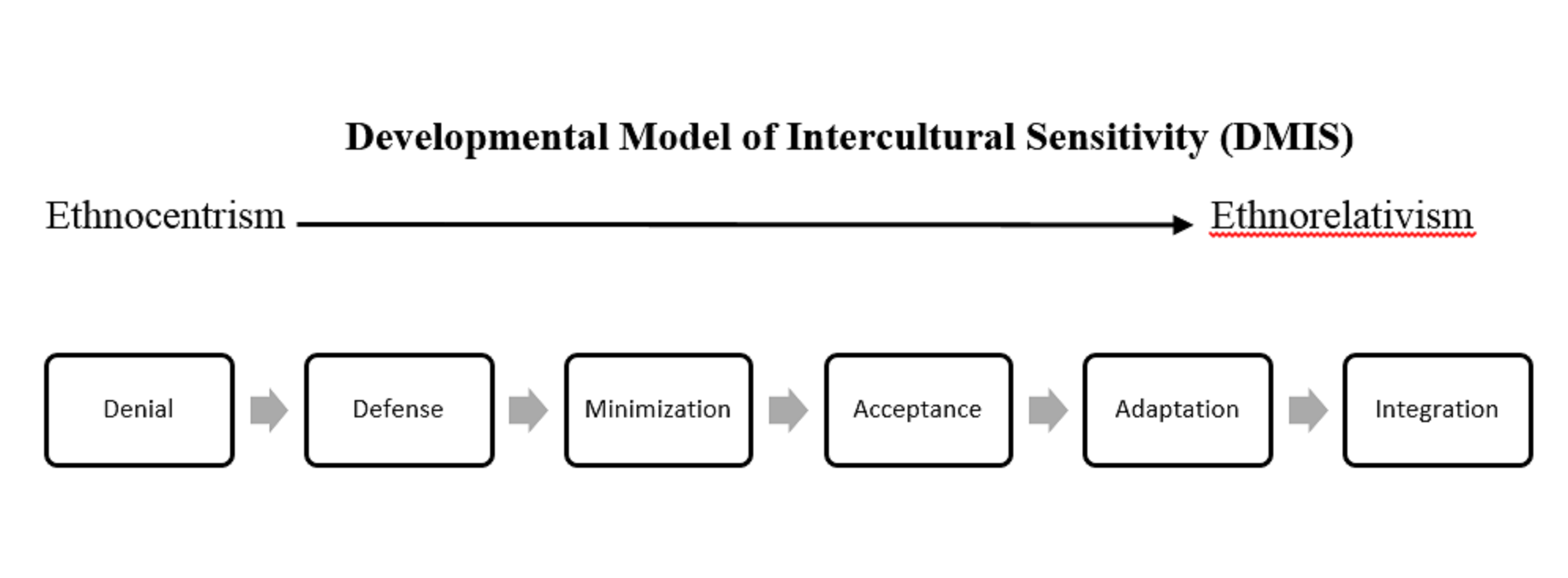
DMIS diagram 2

Explanations:
Ethnocentric – the tendancy of people to evaluate others from their own cultural reference point.
Ethnorelative – the ability to evaluate others using multiple frames of cultural reference.

Denial – the inability to see cultural differences; reflective of individuals who isolate or separate themselves in homogenous groups; segregation; overemphasizing categories (stereotyping).

Defense– recognition of cultural difference coupled with negative evaluations of those whose culture is different from one’s own culture; derogation (belittling other cultures); superiority (looking down on other cultures; prejudice); reversal (looking down on one’s own culture).

Minimization – recognition and acceptance of superficial cultural differences such as eating customs, money, etc., but holding to the belief that all human beings are essentially the same. Everyone shares or should share the same reality—usually that of one’s own reality.

Acceptance – ability to recognize and appreciate cultural difference in terms of both people’s values and behavior. The ability to interpret phenomena within a cultural context and analyze interactions in culture-contrast terms.

Adaptation – individuals use empathy effectively, shifts frame of reference, and understand others across cultural boundaries. Requires action that involves shifting perspective into alternative cultural worldviews and the internalization of more than one worldview without much conscious effort.

Integration – rarely achieved; the ability to move freely within more than one cultural group. The ability to facilitate constructive contact between cultures (cultural mediators).

How far have we come? How far have you come?
2 Accomplishments No One Will Talk About

In a meeting with Ron Clark and Kim Bearden, co-founders of the Ron Clark Academy, I was given the advice that you have to know how to brag on yourself. People won’t always be able to see or hear the good things you do, so sometimes you have to tell them. Since #CaitlynJenner has found mass appeal to break the internet and #Beyonce has to have a Good Morning America special to announce her Vegan lifestyle choice, I feel I am obliged to use my piece of the sphere to share two significant events in my educational experience this year with which I shared a connection. For teachers, our battles are fought and won inside the classroom, and there they stay. However, it is important for me to share these accomplishments with a greater audience.

  1. ZERO WRITTEN REFERALS IN CLASS. Yes! I wrote zero referrals on the students that I taught. Let me set the stage. I taught a remediation class, so I had upwards to 60 students (not the typical of 100+ of regular classrooms). All students who did not meet some standard in math that caused a concern. The population was about half and half girl and guys; half and half black and white; a significant amount of discipline issues; and given that the school overall was 67% free or reduced lunch, a significant amount of low socio-economic status. Those stats make this a HUGE accomplishment, because it showed that people from all of those statistics can stay in class and can have an interest in learning! It was not easy! As a teacher, I was really challenged to rise to the occasion when students showed behaviors that normally had them removed from class, and find ways to solve the issue without compromising my high standards or relinquishing my power by sending them to an administrator. Some of the strategies I used can be found in my blog My true vision of classroom management.
  1. MY FORMER INTERN WAS A TEACHER OF THE YEAR CANDIDATE. I have only had one chance to have an intern in my nine years of teaching, and this year that intern was voted as a Teacher of the Year Candidate for her school! Part of the significance here is that she was part of a Master’s of Arts in Teaching program, a program for non-education majors, who had not had previous teaching experience. I don’t claim to take full responsibility, because teaching takes a great inner desire and drive to be great; but, as an advising teacher, I hope the experiences created during our time helped build and develop the desire and drive that navigated her to that point!

So there are my two accomplishments that I’m sure no one will talk about, but they are MAJOR! The whole reason that I created the W.I.L.L. Educational Services is because I feel I have a calling to make a difference in education, but it is not enough just to use in isolation in my classroom. I wanted to build a platform to share my beliefs, ideas, and strategies on a larger scale. I am also building the framework for my own school; a model institution that I hope can change the face of education and make it THE priority again for all groups of students! To me, these accomplishments are significant because they give credibility to my philosophy. I hope that it gets everyone who reads this more interested in the movement that I am trying to stir; and that you will call on me to help build that desire and drive to make a difference in your school or organization.

Summer Learning

Summer is coming up and I know we are all excited about having more time with our kids. Being an educator, I actually get to spend the whole summer with mine. I also have to begin wondering how I am going to keep my kids entertained. If any of you are like me, I prefer not to have my kids sit idly all summer and not be productive. I also believe in the summer learning loss concept, where students tend to lose a significant amount of academic learning during the summer. So as I try to keep my kids entertained, I also try to keep them academically stimulated without sending them to “summer school.” The key is to place it in a fun environment where they are almost learning without knowing. I am going to share with you some ideas that might be helpful if you also want to keep your kids stimulated. I intended to organize them according to accessibility, cost efficiency, and in some cases parent tolerance; but, it may vary by location for some.

  1. Good old fashion memory games, card games, board games.
  2. Homemade experiments
  3. Learning programs on television (play along)
  4. Learning games on the computer, tablet or phone
  5. Science games from the toy section of local store
  6. Book clubs or summer reading clubs
  7. Summer camps
  8. Environmental excursions (parks, zoos, wildlife refuges).
  9. Discovery learning centers on vacation

Here are a few things to remember about when learning occurs; it happens when it is tied to emotions (fun, happiness), when it is active (hands-on, real-world, real time), and when it is discovered (new ideas, out of comfort zone).  Keep these in mind as you plan your own activities. There are certainly tons of different ideas out there and more to be created!

Think Before You Speak: Have An I.D.E.A About What You Say – A message to the youth in our communities

originally published by Great Black Speaker’s Bureau, August 2, 2013

The transcript of a speech given at the Grantville Parks and Recreation Summer Youth Camp Closing Ceremony, Grantville, GA, July 26, 2013

My name is Nigel Walker. I am a math/science teacher at Smokey Road Middle School in Newnan, and I am also a 3-time published author, speaker and community activist. It is a pleasure to speak with you today. As a teacher and community activist, it is important for me to address the very sensitive matter that we are faced with, as we all are gearing up to return to school in a few days. Right now a 17-yr old young man is laying to rest and the man that took his life is at home. But, the issue that we are protesting is not the biggest issue. It goes deeper than that.

The decision (the verdict) can be loosely interpreted that your reputation can be considered a lethal weapon. You guys and girls that go to school bullying, fighting, arguing with your teachers, using bad language, or doing any of those things in public, period—your attitude might now be considered a lethal weapon. If someone feel threatened by it, most states (the Stand Your Ground states), which includes GA, they “might” have the right to take your life. We can protest all we want, or we can stop giving them the cause to profile us or take us out.

If you have ever been one who complains about why you need to go to school and learn stuff you don’t need, I tell you this. You need an education; you need knowledge to gain credibility. Credibility basically means that what you say can be trusted to be true, accurate, and can be backed up by facts and experience. Credibility is the card that can outweigh the affects of profiling. Credibility is the card that produces justice. Credibility was one of the determining factors of the verdict of the Zimmerman trial.

Trayvon Martin is no longer with us. He could not speak for himself. He could not give us his side of the details of that night. He could not prove how intelligent he was or if he had good manners. His voice was taken with his life. Only what he left behind could speak for him, and during the trial they took his Facebook postings, phone conversations, and pictures as his reputation to damage his credibility. They even used the mannerisms of other witnesses to try to damage their credibility.

The lesson here is that we have to make sure that our education and our reputation build upon our credibility, so they we might have justice on our side. You can do that by thinking before you speak. Have an I.D.E.A. about what you say first. An I.D.E.A is an acronym that I am using to help you remember how your conversations should go when speak in public, or with social media. Remember that facebook, twitter, instagram, all are public domains.

I is Integrity – speak with high esteem and pride for yourself, not putting yourself or others down

D is Decency – speak what is appropriate for any audience; if you can’t say it around everybody, it probably should not be said at all

E is Expression – use intelligent, proper grammar; no slang or profanity

A is Accuracy – speak the truth; earn trust and credibility from others; know what you are talking about; gossip is not accurate

I, for one, know how things go with your friends—the desire to have fun; impressing and entertaining each other; having an identity and your own way of speaking; your own code. It is okay when you are in your own circle, but you have to be careful what picture you paint publically. Look at me; most of you may see me as this really serious teacher, who only reads or do work for fun and likes to fuss at children all the time. Publically, I keep a serious and professional reputation.

But my private hobbies include listening rap; I like Drake, Kanye West, Eminem; my friends and I still jive each other when we get together; I don’t wear suits and ties all the time; I own Sperrys, Polo, Jordans. However, I do spend most of my public time building a positive reputation and credibility, because the reality is that I am an African American male, with dreads, and a car with tint and rims. I can be easily profiled; and by the law, I just might be considered a threat. But, I know not to engage in any physical activity towards anyone, and if anything would end up in court, I have a big enough resume that hopefully would earn me plenty of credibility.

What you guys and girls have to remember is that outsiders don’t always relate to you, and unfortunately, certain actions on your part might now be considered a threat. Also, being a copy cat of what you see or hear on television, in music, or online is not worth your life. Think before you speak. Have an idea about what you say—integrity, decency, expression, and accuracy. Then when you speak, people will listen. Don’t allow others to take your voice. Thank you.

The Art of Storytelling and Desired Outcomes

originally published by Great Black Speaker’s Bureau, November 23, 2013

Slick Rick did it best, and Outcast was a classic as well—the Art of Storytelling. Though the title strikes instant memory of my favorite hip hop artists, the context goes much deeper. The art of storytelling is a time-honored skill that has preserved the history and heritage of many people, places, things, and events. It has also motivated thousands to action with heroin tales of overcoming obstacles against all odds. It is still an art, just de-valued when diminished to a host of elaborate excuses to escape responsibility. Even if there is validity to the story, I still beg to question, what is the desired outcome wished to be reached?

The desired outcome we have for our children should be to produce responsible and critical thinking contributors to society. That does not need discussion of academia verses vocation, since any career or occupation serves as a contribution to society and takes problem solving skills to accomplish. It is simple task mastery, whether intellectually or manually—functioning in society.

How do we accomplish contribution to society in education? Do we finish a task that the student does not want to perform or force others to do it for them? If the student does not have the skill to accomplish the task, do we teach the skill or perform the skill for them and just allow them to watch on the sideline? If the child is unhappy with a situation, do we fix the situation or the child? Situations are too unpredictable to control; however, if we teach the child to meet any situation, we can rest assure that the child will endure.

The true problem with the “art of storytelling” is that it is lacking in solutions and intent to act. In most cases where extra time and care has been spent into crafting the perfect story, there is never attached an equally thought through plan of action. We can build compassion and understanding for misfortune, but how should we proceed from there? What is the desired outcome?   Should we forget about the issue or give a free pass? It seems that some stories are shared to rationalize bad behavior or lack of effort. Should we allow the behavior to continue or offer a reward “just because…”?

What we also fail acknowledge are the undertones to the desired outcomes. You may be looking to catch a break not realizing that you are teaching escape instead of endurance. Arbitrary rewards with no accountability presents the false sense of entitlement and a false perception of the norm. We should be offering solutions that will lead a child to learning how to function in society; not offering excuses for why the student should not meet the expectations. Not meeting the expectations mean not reaching the desired outcome that we should agree as being a contributor to society. I would have never made it out of the projects if I was always justified for being a poor, black male from a low-income single parent family of eight instead of being challenged to endure and overcome.

As the generation of “story-tellers” has entered the real world, we see an increase of the deepening of conflict to the point of pointless rants, raves, conspiracies, and sabotage. Politics have transformed to a similar condition in that sides blame, bicker, and make excuses to relinquish themselves of the responsibilities of the mishaps that are public policy—the policies that dictates our wellbeing. I still await someone to step up and offer real solutions that surpass the pettiness of party lines, class lines, or even racial lines. I often ask myself, is this evidence of a trend that indeed has been filtered through the education system into real life?

In my humble opinion, if we simply replace accountability in the schools and homes, we will offer the expectations a child needs to be prepared to face the world and solve its problems. School should be training for life. What outcomes are we currently preparing student to reach—getting accommodated for what they can’t accomplish; creating a diagnosis for what they can’t accomplish; lowering the expectations for what they can’t accomplish; holding others accountable for what they can’t accomplish? We should teach them conflict resolution, problem solving, and endurance. It has to start somewhere.

Numbers Don’t Lie: The Jay-Z Philosophy and School Reform

originally published by Great Black Speaker’s Bureau, December 11, 2013

News about the 2012 Program for International Student Assessment (PISA) —an international survey used to rank the top 65 global economies in science, math, and reading—has been released and the U.S. is ranked #36. Jay-Z quotes, “men lie, women lie, numbers don’t.” If numbers don’t lie, then what we are doing is not only unsuccessful, but it has been that way for years. When do we allow someone else to take over with creating solutions?

Our ship seems to have the Titanic approach although we have striven for changes in standards for years. I believe in policies like No Child Left Behind, and Race to the Top—in concept only; that concept being that we can reach all students when it comes to achievement. However, the execution doesn’t seem to hit the mark. We are approaching the matter from the wrong angle. If we look at education as a product, we have to start with consumer interest before the bells and whistles. We must start from an inner perspective of value from students and home and then work our way out to standards and accountability. In clinical terms, is there any home accountability?

Right now, there seems to be a very hands-off approach in education on the home front. The perspective from teachers is that we must magically make students achieve even though they may do nothing outside of school to reinforce what is done at school. Parent involvement is sought, but not in the form of excuses to rationalize bad behavior or lack of effort; instead, actively working with the teacher and child to make sure there is reinforcement at home.

School reform needs to begin with a look at belief in capabilities, because it seems that a defeated attitude is the first hurdle. Homes are filled with the “I can’t” attitude from both parent and child that leads to apathy and avoidance. So I want to start with a quiz for parents to dispel the misconceptions about student potential to achieve. Do you think your child is capable of meeting the standards set at school?

Here are 10 questions that can determine if a student is capable of meeting achievement standards:

  1. Does your child know the lyrics to songs?
  2. Has your child ever mastered multiple levels on a video game?
  3. Can your child play any sports at least at an average level?
  4. Has your child ever constructed a structure out of any material (recycled, blocks, paper, etc.)?
  5. Can your child effectively operate electronics (smart phones, tablets, etc.)?
  6. Does your child hold normal conversations with friends, family, or social media?
  7. Has your child ever convincingly lied to you or made excuses for any issue that sounded credible?
  8. Has your child ever cheated on anything, serious or fun (games, activities, etc.)?
  9. Has your child ever successfully carried out a transaction involving money without your help?
  10. Can your child carry out independent routines on a consistent basis (brushing teeth, getting dressed, chores, etc.)?

If you answered yes to any of these questions, your child does have the capacity to learn and achieve. Simply put, it is a function of information processing and performance; learning the steps or important details through information, and using it to carry out a task.

The fact of the matter is that we have taught our children that it’s all about them, but have never included the facet that they are still children and must succumb to boundaries and expectations set for them; hence the “entitlement,” factor we all talk about. We do this by making any excuse to make them feel good about themselves and their present state of progress or maturity however large or small. We do not teach them to hone in on the potential and use it as the driving force to achievement.

In the recent article about the latest release of PISA scores, the author comments on how the top- ranking students from Shanghai, China have the drive and confidence to fulfill their potential. They don’t shy away from hard work, and they believe that if they try hard, the teachers help them become successful. Their culture is built around the value of high achievement. There are many arguments that are made about the relentlessness of their expectations and procedures, but the fact still remains that they are motivated to meet those requirements. They accept the challenge.

The issue that I see locally is that our standards are markedly different and our students aren’t challenged to meet our standards. Our culture is not based on academic achievement. Though some may argue that point, I offer this explanation. Culture is worn on the sleeves of our everyday lives and interactions. You see and hear elements of culture in normal situations. How often is the topic of conversation with our students, their peers, even consistent conversation of families, or portrayal in popular culture really glorifying high academic achievement? I see quite the opposite. If we want change in education, we need to change the culture. No money necessary for that type of reform. Students should be taught to want it, not taught that it should be handed to them. For all of the other drastic pushes for rigor, changing standards, teacher accountability and merit, answer this. How has that worked out for us?

Want is a part of human nature. We are drawn towards what we want and away from what we don’t. It is obvious that if a child does not want any part of an education, they are not going to help a teacher get a raise by passing a standardized test. Students will go as far as to refuse to comply to anything that their parents don’t enforce at home, so how do reach that particular student? We must reach the parent, the home, the culture, and really make education a priority.

2 Cool 4 School – Making Intelligence the Popular Culture (Parent’s Guide)

originally published by Great Black Speaker’s Bureau, May 13, 2014

To inform those who may not have seen the 2 School 4 Cool (Teacher’s Guide) blog, the 2 School 4 Cool initiative is a play on words to the common phrase “Too Cool for School.” It is a statement that exemplifies the idea that what is needed in our society is a complete reversal in popular thought and the priority of education. Due to the effects of the popular culture, prior experiences of past generations, and a seemingly natural development of millennial apathy, education seems to have become the enemy.

If you have ever read any of my earlier blogs, you would have already found out that not only do I serve as a middle school teacher, but I also double as a parent of a middle and elementary school child. It has been an interesting journey being able to see from two different lenses. As I have declared the 2 School 4 Cool initiative, it is important for parents to understand that they play the bigger role. Most people, especially impressionable young people, are quick to side with familiar desires, values, or attributes as opposed to unfamiliar ones. In educational terms, if the parent does not go along with the program, there is no chance to connect with the child. As it relates to the current discussion about Georgia’s State School Report Card, we must remember that the reflection of school and community is transactional. It does not only take a look at what comes out of it, but also what is put into it. So, it is most important that parents get with the idea of making intelligence the popular culture because the home is the gateway of popular culture; it is the exposure site.

An issue that teachers wrestle with when it comes to scores being a reflection of their professional abilities is the issue of how students can come in with an attitude that is against the system, which some cases come from the home. No matter what expert thinks that there are easy ways around it, it is a daunting task to override familiar opposition or apathy. Learning truly does start from home, so we cannot ignore the fact and rest all accountability in the schools. If a parent truly wants to see their child achieve, they must instill the importance of education in their child at home. The following is a list of strategies that parents can use to help them unite with the education system to motivate their child to be 2School 4 Cool.

1. Get the App – Appeal and appease are two different apps. You can appeal to your child by mixing interests with responsibilities. Appeasing, or giving in to your child’s will, creates a false sense that they are in charge and make the decisions. If you are confident with the child making the decisions, try it with your finances, health, or personal issues. As it is transferred to school, they begin to make decisions about whether or not they want to learn, and there lies our biggest challenge.

2. Let Them Learn – Lessons do not only come from books and information; they come from experiences. Experiences involve both success and failure, but most importantly the opportunity for your child to determine the difference between the two. Hovering or sheltering too much not only blocks the failures, it blocks the successes and the chances to learn the difference between the two.

3. Let Them Live – The biggest issue from home is when the parent is so vicariously obsessed with popular culture that they focus on it more than their child’s future. Let them develop their sense of self through a learning process, not a manufactured process through the power of nostalgia. Fads fade quickly, which is probably why adults look for second chances through their children, anyway.

4. Be Optimistic – do not pass on the generational pessimism of “I was never good at it, either.” Give your child the opportunity to be successful. Have high expectations for your child; nurture their potential instead of nursing their weaknesses.

5. Be Open – even if you have never received your answer to “why do I need this topic?” or “when will I ever use this in the real world,” let them explore all areas of learning and gain as much information as they can. It gives them options for the future. Also, let your child be different from other students. Different is not embarrassing unless you make it a big deal. They cannot see their own way if they are following behind everyone else.

6. Be The Motivator – always want more for your child than you had, even if you are fortunate. More is not necessarily in materials; it is in fulfillment of lifelong learning and experiences, and a sense of purpose or state of being. Motivate your child for greatness. If they want to be great, they will want to learn and work hard at being great.

7. Be An Advocate – stand up for what is right for your child, emphasis on “right.” Get involved in their lives and know what is going on. Work with the school to learn what will put your child in the best position to be successful and get on the same page. Give them responsibility, but give them guidance and assurance. They are not ready for life decisions. They need an advocate. They also need you to model making life decisions. Lastly, they need to know how to function the right way, not just the way that they would like it to go.

2 School 4 Cool – Making Intelligence the Popular Culture (Teacher’s Guide)

originally published by Great Black Speaker’s Bureau, May 5, 2014

As a solution to what is now the growing topic of discussion, Georgia’s State School Report Card, I do hereby publicly request that we begin a new initiative for education called “2 School 4 Cool.” Just as simple as the play on words to the common phrase, “Too Cool for School,” it is a statement that exemplifies the idea that what is needed in our society is a complete reversal in popular thought and the priority of education. Due to the fortune of the popular culture, prior experiences of past generations, and a seemingly natural development of millennial apathy, education has become the enemy

To say that education has become less of a priority seems cliche due to its exhaustive expression; but the fact has remained so, and no definitive solution has silenced the thought. One problem is similar to the predicament of stereotypes; when one falls into the preconceived pattern of behavior, it perpetuates the stigma for the entire population. That reigns true in the education profession as well. Most of the complaints of a less prioritized field are addressed by those who work in field. However, when the news plasters test cheating scandals, inappropriate relationships, or mishandled conflicts in education over the media outlets, it casts a shadow over the entire profession and creates a false sense of justification to lack of trust in the education system. From there, generations ahead of the current begin to lower the importance. Viewing the discussions on Georgia’s recent report card, I have yet to see anyone dig deeper into the background of the students to see if they are even motivated to succeed from home, or if education is even on the radar.

Coming from the at-risk population as a student, I see the point; so as a teacher, I want to be a change agent in getting the trust back into the community that education is the “great equalizer,” which gives everyone options for the future no matter race, gender, socioeconomic status, or any other marginalizing subgroup. In fact, it is the purpose that I became a teacher and a speaker. I was first the believer and the over-comer. Not to bore anyone with details, I will say that I went from being in a single-parent family of eight kids in public housing projects to a published poet, author, teacher, and speaker. I owe the credit of the desire of being educated from my mother. Now as an educator, I stand to be a role model that not only is intelligence important for having a choice for future endeavors, but I also seek to show kids that it can be cool to be smart. I aim at putting intelligence back into the popular culture.

This journey has been very methodical; and although I am still actively on this odyssey, I share the method to my madness in hopes that others will get on board and help transform the face of education. As an educator that is on the “front lines” of direct everyday interaction with the students, I feel that it is my duty to be that change agent. Media is to entertain or inform, parents and family are to nurture, community is to support, and school is to develop. Part of the development is actually developing the passion, motivation, and drive to excel. I know I am playing the devil’s advocate by placing such responsibility on the teacher when the common sentiment is that if there is no support or motivation from home, the student will absolutely not comply. The advice that I offer is that we can only change what we can control, and if we do everything in our power to invoke change, there is usually no fault that can be placed for those that feel that we “did not reach.”

In my experience, I have earned the respect from so many of my students that even though teaching can be a great challenge, and I feel that I have so many other talents that could take me in so many other directions, I continue to educate. I truly care and hope to inspire others planning to go into the teaching profession to just care for what you do and the rest will fall into to place. However, not to leave with the overly optimistic, but empty declaration of good hopes, I have compiled a list of seven strategies that exists as part of my professional attributes that has helped gain the respect of the students and helped students value their own education a little more. The following is the list strategies for educators to motivate your students to become 2 School 4 Cool:

  1. Take a personal interest in your students. Find out what they like and what they like to do outside of the classroom. What are their extracurricular activities? How do you relate to their interests? Sometimes the best conversation you will have with a student will be one that is not on subject, but it give you experience on holding conversations with them, period.
  1. Be human. Let them see that you can make mistakes. More importantly, let them see how you resolve mistakes. One of the greatest walls put up between teacher and student is the authoritarian method—the “I say, you do” method or the “I’m right, you’re wrong” method. That makes you the enemy. However, it is not to say the alternative is trying to be their friend either. It looks more like a mentor method—one who has their best interest in heart, guiding them through structure and expectation; not a salesman or dictator.
  1. Be respectful. This is a hard one. In today’s society, there are not many who use or believe in the use of yes or no, sir, please or thank you. Such is even rarer from an irate student. However, I try to remember that even in the heated moments of reprimand or request, I will use respectful language. I also remind them that before they respond, I used respectful language and deserve the same.
  1. Share your story. Most people have a reason for choosing education that resonates with students. Mine just so happens to be similar to a rags-to-riches type story that gives me leverage to relate so similar students.  Also, I use the fact that write poetry and hip hop songs and share my hobbies and interests with the students. I have also been able to use those interests as teaching strategies. You can image that a good number of students look up to me as being a “cool” teacher, so I make sure that add how being serious about education made my successes possible.
  1. Be upfront and honest.  I do not tell my students untruthful statements. I do not volunteer unnecessary information either, but when I say things, I make sure that they are not things that the students cannot call me on later. It may not matter much to the adult, but it matters more than you think to a student. It also keeps them honest. I tell them how discipline is going to work. I even tell them the mannerisms that made them get caught. Many do not agree with that method because they think the students will adapt, but in my experience I have had more students respect me for being upfront. I can also see them turning their opportunities to be sneaky into opportunities to self-correct.
  1. Be a cheerleader. Believe in your students. Tell them that you believe. Sometimes you have to turn around and cheer them on right after you have reprimanded. It shows that consequences are not personal, but learning opportunities. Root for them in class and even outside of class. It reinforces the personal relationship.
  1. Be consistent. If you are going to use the strategies, make sure it is genuine and consistent. Stick to your expectations and be fair. Make any strategies you use part of who you are. Use your gifts and talents. I use poetry and music because it comes natural for me. If you put on an act, the students will figure you out. Part of a student’s purpose in life is to be entertained, but you putting on an act to get them to comply do not amuse them. Even more, when they feel that you are not genuine, it feels like a trick to them. That also makes you the enemy.

The teaching profession is a complex profession like all others. There is no quick fix or “Dummies” guide. However, start with your own personal qualities and you will see change exude from within. It is going to take the spread of such effort to restore education as a priority. We talk about international or state rankings, but they seem to reflect the priority rankings by the country—the whole country, not just the professionals in the field and people in office. We all must stand on a united front and let students know that it is okay to be 2 School 4 Cool.

My true vision of classroom management (EXPERT OPINION).

One thing that I hear from new teachers is that they never heard a true break down of how to manage a classroom when it comes down to getting your own classroom for the first time, so I decided to share some of my professional vision. Some things are things that I think should happen and some are things that I actually do. The evidence that I can share in the success of this is that I did not write one office referral for any of the students in my class this year. Did I have the perfect year? Of course not. But I have had great opportunities to learn my students and their capabilities and it has reaffirmed my belief that all students have the potential to be successful. Sometimes we have to get them out of their own adolescent ways, and these suggestions help.

  1. We should have small class sizes (no more than about 15) so that you can effectively address each student’s educational needs and progress and have a manageable population of parents to consistently contact. Seriously, how feasible is it to consistently contact parents for 30 students in 4 class periods (120 set of parents)? Students are fully aware of that factor. That is why behaviors are repeated even though you call home. They know that now you have called home, there’s less of a chance that you will call and call again because of the size of the student population and extensive turnaround period. They know that! Students that know there is consistent contact begin to stay within the expectations more unless parents have no control either. Teachers need manageable numbers if they are required to keep consistent contact.
  2. Ask for student’s opinion, but let them know that giving opinions comes with the responsibility that the suggestions must follow all rules and expectations, and must lead to gaining knowledge of the subject matter. We are told to give students choice, but without parameters some students may choose to do nothing. It also teaches them responsibility when they can make decisions that can lead to future success. Choice is great, but it need to be guided in students.
  3. Look through grades (in all classes) to see similarities and differences. Address the patterns with student, parent, other teachers, or administrators depending on potential problems you might see. Personal story: I recently did this and shared with the students that I knew all of their grades in all of their classes and a student responded that a teacher has never talked to them about something like that. I cannot factually substantiate the “never” part, but I’m sure they haven’t been talked to enough to feel it is routine.
  4. Tell your students the purpose of the activities. ALL activities should have a purpose or should lead to a better understanding to a concept. It should also connect to what’s coming up or link back to what was discussed. Try to stay away from isolated practicing that is not connected, it comes off as “busy work.”
  5. Must be consistent with expectations. If you don’t allow gum, you should not chew gum. If the students aren’t allowed to eat in class, you should not eat in front of them. I know you are the adult, but your students do care about that, all they know is that you are doing something that you asked them not to do and they don’t think it is fair. You can spend your extra time trying to explain fairness and adult privilege, or you can be consistent and save a lot of time. CONSISTENCY SAVES TIME!
  6. You should carefully explain expectations for cooperative groups or even less structured whole class activities. They need to know that a little unstructured behavior is okay during the less structured activity, but it cannot be carried on past that time. You must take extra time to teach them that expectation or less structured activities will not work.
  7. Students need to talk. They need to learn how to talk things out. They need learn to be courteous during conversations. You must establish an environment of tolerance and respect so that your shy students will have enough confidence to speak. This helps students formulate their thought processes and learn from others.
  8. Your students need to know your purpose for teaching and your purpose should be for development of all of your students. If neither of these exists in your professional vision, you should take a serious look at your professional choice.
  9. You must learn personalities so that you realize that all responses from students are not necessarily defiance, anger, or disrespect; sometimes it is a typical mannerism that the student possesses. It is important to let them know that you are not satisfied with the response, but you should also give the student opportunity and an example that will help them fix their mannerisms. Simply removing a student from the environment will not solve the fact that the student possesses such mannerism. Teaching them to find better responses will solve it.
  10. You must be observant of your students. Learn their mannerisms. Learn how they operate. Human behavior is more predictable than you think. Students don’t know that, and when you can articulate a behavior to a student that they perceive you don’t notice, it makes them conscious of your keen perception and leads to more self-regulating behavior from the students. TRY IT!
  11. Remind your students of the importance of their presence in the class and it is their responsibility to take their opportunities seriously. You will have to show them how it looks to take things seriously. I often equate it to their personal lives. Their family is important to them; their friends; their prized possessions. They don’t want harm coming to their family, friends, or prized possessions. They don’t forget important dates or events coming. They are always checking to make sure that family, friends, and prized possessions are in good welfare.  A similar view should be taken to grades and class. Once a student makes it important, they are concerned about harmful (failing) grades, they keep up with assignments, supplies, and important dates (like tests), and they make sure they are in good standing overall in the class (grades, behavior, etc.).
  12. EVERYTHING WORKS! There is so much research out there that claims it’s the best strategy. Truth is there are a lot of effective strategies. It is best to switch things up. Nothing in isolation will consistently be engaging, and sometimes you have to focus on the learning process in structured and methodical moments. You cannot play around too much and you cannot be too serious. You also cannot have the “my way or the highway” attitude. The purpose of common core standards and all the other standards that have been formed in the world were created to give students steps and strategies to learn.  Specifically in math, I aim at learning as many strategies as I can so that I can find one that will be most helpful to each of my students. There are several ways to solve some math problems, so I try to offer students a choice. The goal to me is concept obtainment, and students should not be forced to do it one way if there are other ways available.
  13. Show the appropriate emotions. I feel like this is the one thing that most people get wrong most of the time. Opinions are different inside and outside of classroom and school doors. Some people say you have to be bright and chipper to engage students; some say you have to be stern and emotionless to make them obey. Some teachers try to win over students by acting like their friends, and some make the authority level very clear. What many people don’t realize is how much other people (and students specifically) read your emotions. Any emotion at the inappropriate time can be detrimental. The overly enthusiastic and nice person tend to lose respect because students don’t take expectations seriously. The overly authoritative lose respect because students see the teacher as just plain out mean and uncaring. Students find appropriateness through emotions. It is important to be happy and cheerful when they do good things, make good decisions, and make good efforts (even if the product isn’t perfect). That is much different than praising them for whatever they do, which establish a false sense of accomplishment. You should not give into their silly antics at any time (structured or unstructured) because they will always try to get you to break, especially during inappropriate moments. In short, be strict to keep expectations consistent, be serious in all serious moments, have joy in good and joyous times, and even be silly when appropriate, but make sure everything has its appropriate place.
  14. Stay in communication with your students. Talk to them. Talk to them a lot. Learn about them. Find their interests. Get as far into their lives as appropriate and as they will let you. They respect your interest in them. They will respect you. They will open up to you. They will be on your side and they will encourage other students to be on your side. This is a huge accomplishment in classroom management.

Each of these are relational based suggestions because as I have learned through my professional experience and from my mentors, relationships should come first. No matter what size classes I’ve had, the majority of my student respect my expectations. To be honest, I can predict the ones who would consider me as being mean and the ones who won’t be successful because it is always the ones who refuse to respect my expectations and whose parents take the side of the student no matter right or wrong. However, the structure of my room also provides the documentation that I am consistent and fair and try to provide all students the same opportunity to be successful and think that is what all teachers want.