
With the glaring pink elephant in the room, or should I say black, white and brown elephant, it is impossible to ignore the fact that race is a hot issue. Dealing with crime, punishment, heritage, and so on, it begs us to take a look at where we are in the process of race relations and how far have we come? Instead of trying to answer that question specifically, I am taking the academic approach and providing a continuum (a line of perspective) for all to make their own evaluations. This comes from one of my doctoral classes on diversity and provides an interesting scope and sequence to our own perspective on race/cultural differences. The information was retrieved from:
Cushner, K. H., McClelland, A., & Safford, P. (2015). Human diversity in education: An intercultural approach. 8th ed. New York, NY: McGraw-Hill.
So feel free to take a look, make your own evaluations, and share if you wish. Change starts from within.
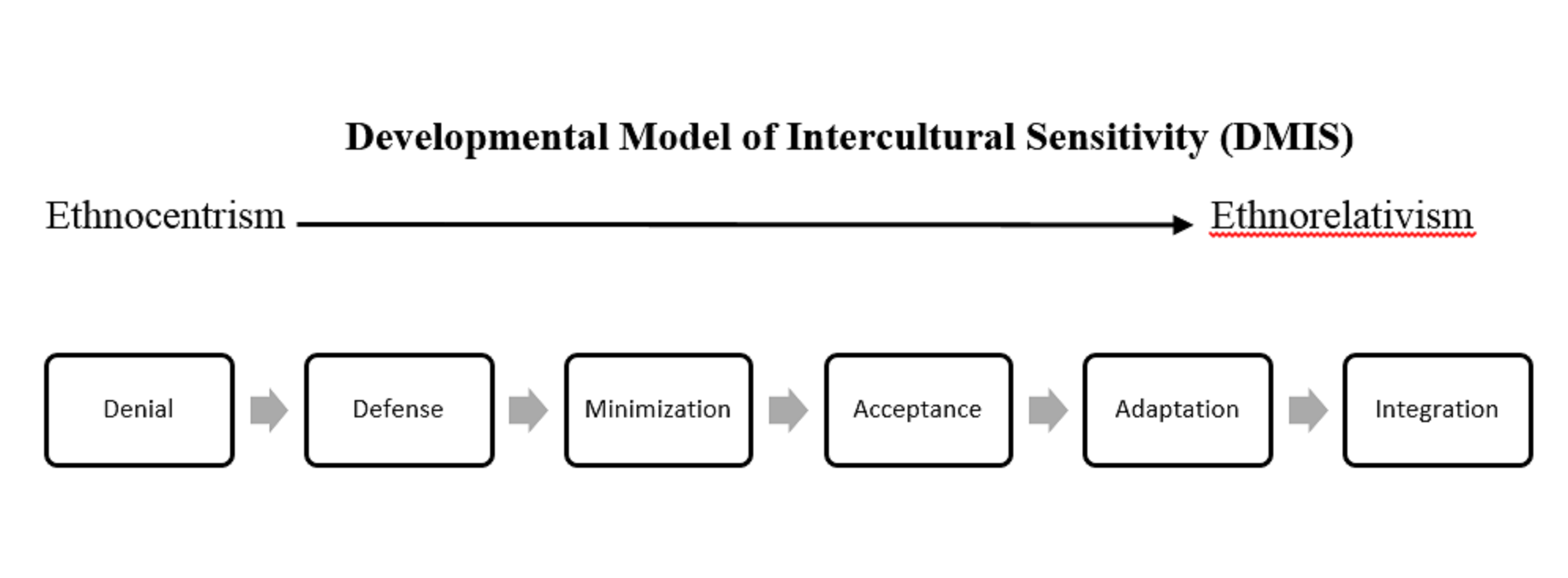
Explanations:
Ethnocentric – the tendancy of people to evaluate others from their own cultural reference point.
Ethnorelative – the ability to evaluate others using multiple frames of cultural reference.
Denial – the inability to see cultural differences; reflective of individuals who isolate or separate themselves in homogenous groups; segregation; overemphasizing categories (stereotyping).
Defense– recognition of cultural difference coupled with negative evaluations of those whose culture is different from one’s own culture; derogation (belittling other cultures); superiority (looking down on other cultures; prejudice); reversal (looking down on one’s own culture).
Minimization – recognition and acceptance of superficial cultural differences such as eating customs, money, etc., but holding to the belief that all human beings are essentially the same. Everyone shares or should share the same reality—usually that of one’s own reality.
Acceptance – ability to recognize and appreciate cultural difference in terms of both people’s values and behavior. The ability to interpret phenomena within a cultural context and analyze interactions in culture-contrast terms.
Adaptation – individuals use empathy effectively, shifts frame of reference, and understand others across cultural boundaries. Requires action that involves shifting perspective into alternative cultural worldviews and the internalization of more than one worldview without much conscious effort.
Integration – rarely achieved; the ability to move freely within more than one cultural group. The ability to facilitate constructive contact between cultures (cultural mediators).
How far have we come? How far have you come?
 W.I.L.L. Educational Services, LLC